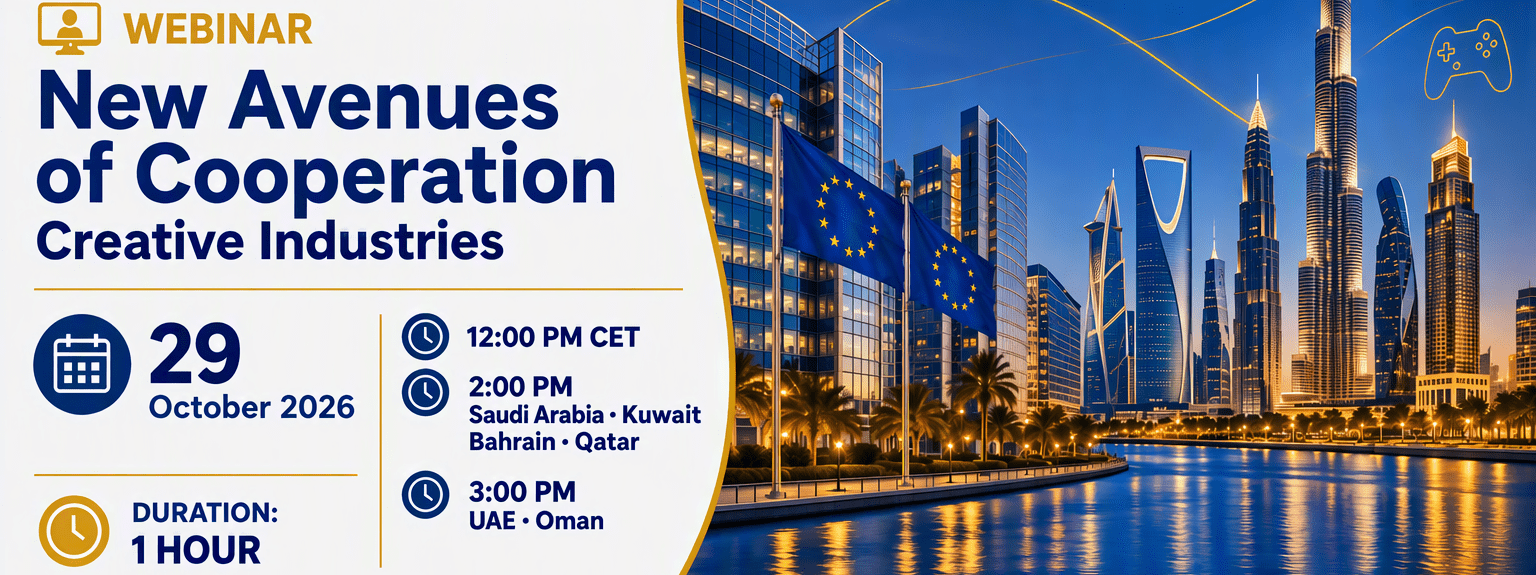
As part of the EU–GCC Dialogue on Economic Diversification II, a project aimed at strengthening economic cooperation between the European Union and the Gulf Cooperation Council, we are pleased to invite you to the New Avenues of Cooperation - Creative Industries webinar. It is the 3rd webinar in a reflection series from the 9th EU-GCC Business Forum held in Kuwait in 2025.
Cultural and creative industries are gaining prominence as contributors to economic diversification, entrepreneurship, innovation and international trade across the GCC and EU. Beyond their cultural significance, these industries generate economic value through intellectual property, creative products and services, new business models and cross-sector innovation.
Realising this potential requires an enabling environment in which creative enterprises can develop, access markets, protect and commercialise intellectual property, and secure appropriate financing and investment. While GCC countries are advancing ambitious economic diversification agendas and developing their creative industries ecosystems, both the EU and GCC face challenges in ensuring that policy frameworks, institutional support systems and market conditions effectively translate creative potential into accessible business opportunities, sustainable enterprise growth and international competitiveness.
Building on the discussions of the 9th EU–GCC Business Forum in Kuwait, this webinar will bring together international creative economy expertise and entrepreneurial perspectives from Kuwait and Saudi Arabia to explore what is needed for creative industries to thrive and for businesses from the EU and GCC to access each other's markets, develop commercial partnerships and pursue investment opportunities.
The session will introduce the key policy, regulatory, institutional and ecosystem conditions that enable creative industries development, followed by first-hand entrepreneurial perspectives on how these conditions translate into business realities, opportunities and challenges within GCC markets.
Particular attention will be given to three interconnected dimensions:
- Trade and market access: Strengthening domestic and international market opportunities, facilitating cross-border trade and business partnerships, and improving access to distribution networks.
- Intellectual property and commercialisation: Enabling creative enterprises to protect, manage, license and monetise their intellectual assets, including across borders.
- Funding, finance and investment: Developing accessible and appropriate financial pathways for creative businesses at different stages of growth, including opportunities for cross-border investment and cooperation.
The discussion will explore how closer EU–GCC cooperation can help address practical business needs, strengthen creative industries ecosystems and facilitate partnerships between enterprises, intermediaries, investors and institutions.
The webinar aims to generate a shared understanding of the enabling conditions required for competitive, investment-ready and internationally connected creative industries, informed by both international expertise and entrepreneurial experience.
Through the exchange, the session will seek to:
- Identify business opportunities and barriers affecting creative enterprises seeking to access markets, establish partnerships, trade and invest within and between the EU and GCC regions.
- Highlight priorities for improving the enabling environment, providing policymakers and relevant institutions with practical insights into how regulatory frameworks, governance arrangements and business support mechanisms can better respond to entrepreneurial needs.
- Identify opportunities for EU–GCC cooperation, including cross-border commercial partnerships, investment facilitation, strategic partnerships for policy implementation, intermediary development and ecosystem strengthening, as well as longer-term institutional cooperation mechanisms that improve market access, business development support and the enabling conditions for sustainable creative industries growth.
These insights will contribute to identifying priorities for a more structured EU–GCC creative industries dialogue, connecting entrepreneurial needs with policy development, institutional support and future opportunities for strategic cooperation.